- 发文标题: Applying the Quality Management Standards to AI-Enabled Technological Tools: Guide 1: Common Conceptual Foundation / 将质量管理准则应用于人工智能赋能的技术工具——指南1:通用概念基础
- 发文机关: IAASB
- 发布日期: 2026-10-28
- 原文链接: IAASB
Applying the Quality Management Standards to AI-Enabled Technological Tools: Guide 1: Common Conceptual Foundation
将质量管理准则应用于人工智能赋能的技术工具——指南1:通用概念基础
Status of This Document / 文件的地位
The IAASB approved this document on October 28, 2026, ahead of Guides 2 to 4. This is a pre-final version of Guide 1. As the IAASB continues to develop the guide series, it may identify matters to update, add, or remove to support the cohesiveness of the guide series. In mid-2027, the IAASB expects to publish all the guides together as one integrated guide series, including in a digital format designed for easy navigation and improved accessibility.
IAASB 于 2026 年 10 月 28 日先于指南 2 至 4 批准了本文件。这是指南 1 的定稿前版本。随着 IAASB 继续编制本指南系列,可能会发现需要更新、增加或删除的事项,以保持本指南系列的连贯性。IAASB 预计于 2027 年年中将所有指南汇总发布为一个完整的指南系列,其中包括便于导航和提高可访问性的数字化格式。
How Guide 1 Is Organized / 本指南的编排结构
1.Guide 1 is read together with the Introduction to the Guide Series, which explains the purpose, status and audience of the guide series. Guide 1 sets out the concepts on which Guides 2 to 4 build. It is organized as follows:
- Section 1 explains when a use of an AI-enabled technological resource is within the scope of the guide series.
- Section 2 sets out the foundation in ISQM 1 and ISA 220 (Revised) at the firm and engagement levels.
- Section 3 describes the life cycle of an AI-enabled technological tool at the firm, which Guides 2 to 4 follow.
- Section 4 explains how the firm applies its risk assessment process to AI-enabled technological tools, including the risk assessment considerations that Guides 2 to 4 draw on.
- Appendix 1 provides illustrative examples of uses within and outside the scope of the guide series.
- Appendix 2 is the glossary.
1.指南 1 与《指南系列引言》结合阅读,后者阐述本指南系列的目的、地位及适用对象。指南 1 阐明了指南 2 至 4 所依托的概念,编排如下:
- 第 1 节阐述人工智能赋能的技术资源的使用在何种情况下属于本指南系列的适用范围。
- 第 2 节确立事务所层面与业务层面在 ISQM 1 与 ISA 220(修订版)中的准则基础。
- 第 3 节描述人工智能赋能的技术工具在事务所的生命周期(指南 2 至 4 均遵循该生命周期)。
- 第 4 节阐述事务所如何将风险评估程序应用于人工智能赋能的技术工具,包括指南 2 至 4 所借鉴的风险评估考量因素。
- 附录 1 提供属于和不属于本指南系列适用范围的使用情形说明性示例。
- 附录 2 为术语表。
Terms shown in teal, like AI-enabled technological tool, are described in the glossary in Appendix 2.
以蓝绿色显示的术语(如“人工智能赋能的技术工具”)在附录 2 术语表中进行了说明。
1.Scope of the Guide Series / 1.指南系列的适用范围
2.The guide series focuses on AI-enabled technological tools. These tools incorporate, or provide access to, one or more AI systems. They may be general-purpose, making broad functionality available that supports many uses, or may take the form of a specific application, agent or workflow designed for a defined purpose.
2.本指南系列重点关注人工智能赋能的技术工具(AI-enabled technological tools)。这些工具包含或提供对一个或多个 AI 系统的访问。它们可以是通用型的,提供支持多种用途的广泛功能;也可以是针对特定目的设计的专门应用程序、智能体(agent)或工作流程。
3.An AI-enabled technological tool may use generative AI, agentic AI, other forms of machine learning or a combination of AI technologies. These labels are not always clear-cut and may change as technologies evolve. The guide series therefore focuses on the functionality made available and how it is used, rather than establishing rigid boundaries among types of AI.1
3.人工智能赋能的技术工具可以使用生成式 AI(generative AI)、智能体 AI(agentic AI)、其他形式的机器学习,或多种 AI 技术的组合。这些标签并不总是界限分明的,并且可能会随着技术的演进而变化。因此,本指南系列侧重于所提供的功能及其使用方式,而非在各类 AI 之间设立僵化的界限。1
4.The applicability of the guide series depends on the intended use or category of use of an AI-enabled technological resource, rather than its product name or its capabilities. What makes the resource an AI-enabled technological tool, and thereby brings that use within the scope of the guide series, is that it facilitates the design or performance of an engagement procedure in obtaining evidence. For an audit, such engagement procedures are audit procedures to obtain sufficient appropriate audit evidence.2 Accordingly, the same general-purpose AI application or audit platform may be within the scope of the guide series for one intended use or category of use and outside it for another. The figure below illustrates this.
4.本指南系列的适用性取决于人工智能赋能的技术资源的预期用途或使用类别,而非其产品名称或能力。使该项资源成为人工智能赋能的技术工具,并进而将该使用纳入本指南系列适用范围的关键,在于它有助于在获取证据时设计或执行业务程序。对于审计,此类业务程序即为获取充分、适当审计证据的审计程序。2因此,对于同一种通用 AI 应用程序或审计平台,某一种预期用途或使用类别可能属于本指南系列的范围,而另一种则可能不在其范围内。下图对此进行了说明。

Appendix 1 provides illustrative examples.
附录 1 提供了说明性示例。
5.Some uses are outside the scope of the guide series because they do not facilitate the design or performance of an engagement procedure in obtaining evidence. Examples include administrative uses and uses that support the direction, supervision and review of the engagement, such as tracking the status of open review notes.3 Direction, supervision and review are part of engagement-level quality management under ISA 220 (Revised) and extend to work performed using AI-enabled technological tools (see paragraph 22).
5.某些使用情形不属于本指南系列的适用范围,因为它们并不有助于在获取证据时设计或执行业务程序。示例包括行政管理用途,以及支持业务指导、监督与复核的用途(例如跟踪未决复核意见的状态)。3指导、监督与复核属于 ISA 220(修订版)项下业务层面质量管理的组成部分,并延伸适用于利用人工智能赋能的技术工具所执行的工作(参见第 22 段)。
6.AI-enabled technological resources may also be used in other parts of the firm’s operations or SOQM, for example, to support resource allocation or the firm’s monitoring and remediation process. These uses, like those above, involve technological resources as that term is described in ISQM 1,4 rather than technological tools (see paragraph 1 of the Introduction to the Guide Series).
6.人工智能赋能的技术资源亦可用于事务所运营或质量管理体系的其他部分,例如支持资源配置或事务所的监控与整改程序。与上述用途一样,这些使用涉及的是 ISQM 1 中所述的“技术资源”4,而非“技术工具”(参见《指南系列引言》第 1 段)。
7.The firm determines the intended use or category of use when applying its risk assessment process, before the tool is deployed. In doing so, the firm may consider relevant functionality beyond the intended use or category of use.
7.事务所在应用其风险评估程序时,在工具部署之前确定其预期用途或使用类别。在确定过程中,事务所可以考量超出预期用途或使用类别的相关功能。
8.The firm establishes policies or procedures that engagement teams apply when using the tool. Policies are statements of what should or should not be done, and procedures are actions to implement policies.5 The firm may communicate these policies or procedures through its methodology, training or other communications. The firm may enforce some policies or procedures through the tool itself (see Section 4.4). A new or expanded use not addressed by those policies or procedures may call for consultation, for example with those responsible for the tool, or further consideration by the firm before the tool is used in that way.
8.事务所建立业务团队在使用工具时应遵循的政策或程序。政策是对应当做或不应当做的事项的陈述,而程序是落实政策的具体行动。5事务所可以通过其方法论、培训或其他沟通渠道传达这些政策或程序。事务所亦可以通过工具本身强制执行某些政策或程序(参见第 4.4 节)。未被这些政策或程序涵盖的新用途或扩展用途,可能需要在以该方式使用工具之前进行咨询(例如向工具负责人咨询),或由事务所进一步考量。
9.Where an AI-enabled technological resource assists engagement team members in preparing engagement documentation, the test in paragraph 4 applies. For audits of financial statements, ISA 230 requires documentation of the procedures performed, their results and the evidence obtained, and significant matters arising and the conclusions reached on them.6
9.当人工智能赋能的技术资源协助业务团队成员编制业务工作底稿时,适用第 4 段中的检验标准。对于财务报表审计,《国际审计准则第230号》(ISA 230)要求记录已执行的程序、程序的结果与获取的证据,以及产生的重大事项和得出的结论。6
10.Such a use is within the scope of the guide series where the resource facilitates the design or performance of an engagement procedure in obtaining evidence (i.e., it is a technological tool). For example, the use of a tool may include extracting and analyzing information from source documents, or preparing a first draft of documentation from the entity’s documents or transcripts of discussions with the entity, which engagement team members then evaluate.
10.若该项资源有助于在获取证据时设计或执行业务程序(即其属于技术工具),则该使用属于本指南系列的适用范围。例如,工具的使用可能包括从原始文件中提取和分析信息,或者根据实体的文件或与实体讨论的文字记录起草工作底稿初稿,随后由业务团队成员进行评估。
11.However, where the resource only records, organizes, or expresses work already performed and conclusions already reached by engagement team members, without adding to or revising the results or conclusions of that work, that use is outside the scope of the guide series.
11.然而,若该项资源仅用于记录、整理或表达业务团队成员已执行的工作和已得出的结论,而未对该项工作的结果或结论增加内容或进行修订,则该使用不属于本指南系列的适用范围。
12.Placing a use outside the scope of the guide series does not make engagement documentation less important. Engagement documentation remains central to engagement quality. The quality objective in ISQM 1 that addresses engagement documentation and, for audits of financial statements, the requirements of ISA 230 apply to engagement documentation however it is prepared.
12.将某种使用归入本指南系列的适用范围之外,并不意味着业务工作底稿的重要性有所降低。业务工作底稿依然是业务质量的核心所在。ISQM 1 中针对业务工作底稿的质量目标,以及对于财务报表审计而言 ISA 230 的各项要求,无论工作底稿以何种方式编制,均普遍适用。
Uses of AI Outside the Scope of This Guide Series / 本指南系列适用范围之外的人工智能应用
The scope of the guide series does not limit the application of ISQM 1 or ISA 220 (Revised). Those standards apply to the technological resources relevant to the firm’s SOQM and to the performance of engagements, whether or not they are AI-enabled and whether or not a particular use is within the scope of the guide series.7
本指南系列的适用范围并不限制 ISQM 1 或 ISA 220(修订版)的适用。这些准则适用于与事务所质量管理体系以及业务执行相关的技术资源,无论其是否由人工智能赋能,也无论特定使用是否属于本指南系列的适用范围。7
A use outside the scope of the guide series may still give rise to quality risks. For example, an administrative use that processes confidential engagement information may give rise to quality risks relating to confidentiality, and a use that drafts engagement documentation from completed work may give rise to quality risks relating to the accuracy of that documentation. The firm considers such uses when identifying and assessing quality risks and designing and implementing responses under ISQM 1.8
超出本指南系列适用范围的使用仍可能引发质量风险。例如,处理保密业务信息的行政管理类使用可能会引发与保密性相关的质量风险;而从已完成的工作中起草业务工作底稿的使用,可能会引发与该底稿准确性相关的质量风险。事务所在根据 ISQM 1 识别和评估质量风险以及设计和实施应对措施时,会考量此类使用。8
13.The IAASB may consider broader uses of AI-enabled technological resources for future IAASB non-authoritative material informed by its approach to addressing technology-related matters.9
13.IAASB 在其应对技术相关事项的方法的指导下,可能会在未来的 IAASB 非权威材料中考虑人工智能赋能的技术资源的更广泛用途。9
2.Foundation in the IAASB’s Quality Management Standards / 2.以 IAASB 质量管理准则为基础
2.1 Firm-Level and Engagement-Level Quality Management / 2.1 事务所层面与业务层面的质量管理
14.The following objective in ISQM 1 is the overall reference point for the guide series.
14.ISQM 1 中的下列目标是本指南系列的总括性参照基准:
FROM THE STANDARD / 准则原文
Objective, ISQM 1, paragraph 16 / 目标,ISQM 1 第 16 段
The objective of the firm is to design, implement and operate a system of quality management for audits or reviews of financial statements, or other assurance or related services engagements performed by the firm, that provides the firm with reasonable assurance that:
(a) The firm and its personnel fulfill their responsibilities in accordance with professional standards and applicable legal and regulatory requirements, and conduct engagements in accordance with such standards and requirements; and
(b) Engagement reports issued by the firm or engagement partners are appropriate in the circumstances.会计师事务所的目标是针对其执行的财务报表审计或审阅业务,或者其他鉴证业务或相关服务业务,设计、实施和运行质量管理体系,使事务所能够合理保证:
(a)会计师事务所及其人员按照专业准则以及适用的法律法规的规定履行职责,并按照此类准则和法规的规定执行业务;
(b)会计师事务所或项目合伙人出具的业务报告在具体情况下是恰当的。
15.The quality objective in paragraph 34(f) of ISQM 1, which directly addresses technological resources, is relevant when AI-enabled technological tools are used. Where an AI-enabled technological tool, or a relevant element of it, is obtained from a service provider, the quality objective in paragraph 34(h) of ISQM 1, addressing the appropriateness of resources obtained from service providers, is equally relevant.
15.ISQM 1 第 34(f) 段直接针对技术资源的质量目标,在使用人工智能赋能的技术工具时具有相关性。若人工智能赋能的技术工具或其相关组成要素来自服务提供商,则 ISQM 1 第 34(h) 段针对从服务提供商处获取资源的恰当性的质量目标同样具有相关性。
FROM THE STANDARD / 准则原文
Technological Resources, ISQM 1, paragraph 34(f) / 技术资源,ISQM 1 第 34(f) 段
Appropriate technological resources are obtained or developed, implemented, maintained, and used, to enable the operation of the firm’s system of quality management and the performance of engagements.
获取或开发、实施、维护并使用恰当的技术资源,以支持事务所质量管理体系的运行和业务的执行。Service Providers, ISQM 1, paragraph 34(h) / 服务提供商,ISQM 1 第 34(h) 段
Human, technological or intellectual resources from service providers are appropriate for use in the firm’s system of quality management and in the performance of engagements, taking into account the quality objectives in paragraph 34(d), (e), (f) and (g).
考虑第 34(d)、(e)、(f) 和 (g) 段中的质量目标,从服务提供商处获取的人力、技术或智力资源适合用于事务所的质量管理体系和业务执行。
16.ISQM 1 describes a firm’s SOQM as operating in a continual and iterative manner10 and being responsive to changes in the nature and circumstances of the firm and its engagements. It also does not operate in a linear manner. The eight components of the SOQM are interrelated.11 AI-enabled technological tools may therefore create or affect quality risks across the SOQM and are not solely a matter for the resources component.
16.ISQM 1 将事务所的质量管理体系描述为以持续且迭代的方式运行10,并积极响应事务所及其业务性质和具体情况的变化。质量管理体系的运行亦非线性的,其八大组成要素相互关联。11因此,人工智能赋能的技术工具可能会在整个质量管理体系的各个组成要素中产生或影响质量风险,而不仅仅是资源要素专属的事项。
17.Using an AI-enabled technological tool may also affect the achievement of other quality objectives in ISQM 1, including those relating to the following components of the SOQM:
- Governance and leadership;
- Relevant ethical requirements;12
- Acceptance and continuance;
- Engagement performance;
- Human and intellectual resources; and
- Information and communication.
The firm identifies and assesses the related quality risks through its risk assessment process (see Section 4), and designs and implements responses in the components concerned. Its monitoring and remediation process provides information about the design, implementation and operation of those responses, and the firm remediates any deficiencies identified (see Guide 4). Not every intended use or category of use of an AI-enabled technological tool affects each of these components.
17.使用人工智能赋能的技术工具还可能影响 ISQM 1 中其他质量目标的实现,包括与质量管理体系下列组成要素相关的质量目标:
- 治理和领导层;
- 相关职业道德要求;12
- 业务承接与保持;
- 业务执行;
- 人力资源与智力资源;
- 信息与沟通。
事务所通过其风险评估程序识别并评估相关质量风险(参见第 4 节),并在相关要素中设计和实施应对措施。监控和整改程序提供有关这些应对措施的设计、实施和运行的信息,且事务所对识别出的任何缺陷进行整改(参见指南 4)。并非人工智能赋能的技术工具的每一种预期用途或使用类别都会影响上述所有要素。
18.Application material in paragraph A105 of ISQM 1 sets out matters the firm may consider when obtaining, developing, implementing and maintaining an IT application. These include:
- The completeness and appropriateness of data inputs and confidentiality of data;
- Whether the application operates as designed and its outputs achieve their intended purpose;
- The general IT controls that support its continued operation; and
- The specialized skills and training needed to use it, and procedures explaining how it operates.
18.ISQM 1 第 A105 段的应用指南列出了事务所在获取、开发、实施和维护 IT 应用程序时可能考量的事项。这些事项包括:
- 数据输入的完整性与恰当性,以及数据的保密性;
- 应用程序是否按设计运行,其输出是否达到预期目的;
- 支持其持续运行的信息技术一般控制;
- 使用该程序所需的专业技能与培训,以及解释其如何运行的操作规程。
19.Work performed by a network or service provider may provide important information and support, but the firm retains responsibility for its SOQM and for determining whether a resource is appropriate for use in the firm’s circumstances. Paragraphs 50 to 54 of ISQM 1 address network requirements or network services. Paragraphs A110 to A113 of ISQM 1 address resources obtained from service providers. Guide 2 addresses how the firm may use information and work from its network or service providers.
19.由网络或服务提供商执行的工作可能提供重要的信息与支持,但事务所仍对其质量管理体系,以及确定某项资源是否适合在事务所的具体情况下使用承担责任。ISQM 1 第 50 至 54 段涉及网络要求或网络服务,第 A110 至 A113 段涉及从服务提供商处获取的资源。指南 2 阐述了事务所可以如何利用来自其网络或服务提供商的信息和工作。
20.Firm-level and engagement-level quality management operate together. At the firm level, the firm:
- Determines which tools or functionality to make available;
- Identifies and assesses quality risks; and
- Designs and implements responses, such as approval conditions, methodology and training, controls over access and information, involvement of individuals with specialized skills or expertise, and implementation support.
20.事务所层面与业务层面的质量管理协同运行。在事务所层面,事务所:
- 确定提供哪些工具或功能;
- 识别并评估质量风险;
- 设计并实施应对措施,例如批准条件、方法论与培训、访问权限与信息控制、具备专业技能或专长的人员参与,以及落地实施支持。
21.At the engagement level, the engagement team applies the firm’s policies or procedures in the circumstances of the engagement, using the resources the firm makes available, such as tools and methodology, and information communicated by, or obtained from, the firm. The engagement team also communicates relevant information from the engagement to the firm.13
21.在业务层面,业务团队在具体业务情况下应用事务所的政策或程序,利用事务所提供的资源(如工具和方法论)以及由事务所沟通或从事务所获取的信息。业务团队还向事务所沟通来自业务的相关信息。13
22.For audits of financial statements, the engagement partner takes overall responsibility for managing and achieving quality on the engagement.14 This includes determining that sufficient and appropriate resources, including technological resources, are assigned or made available to the engagement team,15 and taking responsibility for the direction and supervision of engagement team members and the review of their work, including work performed using AI-enabled technological tools.16
22.对于财务报表审计,项目合伙人对管理和实现业务质量承担总体责任。14这包括确定为业务团队分配或提供了充分且恰当的资源(包括技术资源)15,并对指导、监督业务团队成员以及复核其工作(包括使用人工智能赋能的技术工具执行的工作)承担责任。16
23.An AI-enabled technological tool is a resource. The firm and the engagement team, including the engagement partner, retain the responsibilities required of them by the standards.17 This remains the case when a tool carries out a large part of the work involved in an engagement procedure. The figure below illustrates how firm-level and engagement-level quality management operate together, and where human involvement fits.
23.人工智能赋能的技术工具是一项资源。事务所和业务团队(包括项目合伙人)仍承担准则要求其承担的责任。17即便工具执行了某项业务程序中涉及的大部分工作,情况依然如此。下图展示了事务所层面与业务层面的质量管理如何协同运作,以及人员参与在其中的位置。

24.Human involvement is an important part of how the firm and the engagement team fulfill their responsibilities when a tool is used. At the firm level, human involvement may include, for example, evaluating a tool before deployment, approving it for use, monitoring its performance and making available individuals with specialized skills or expertise. At the engagement level, it may include directing the use of the tool, evaluating its outputs or actions, supervising and reviewing work, and intervening when needed, for example to challenge an output or to override or reverse an action.
24.在使用工具时,人员参与是事务所与业务团队履行其职责的重要途径。在事务所层面,人员参与可包括:在部署前评估工具、批准其投入使用、监控其运行表现,以及提供具备专门技能或专长的人员支持。在业务层面,人员参与可包括:指导工具的使用、评估其输出或行为、监督和复核工作,以及在需要时进行干预(例如质疑某项输出、推翻或撤销某项操作)。
25.Whether human involvement is effective may depend on whether that involvement is reasonably capable of addressing the matter it is intended to address, and whether the individuals involved have:
- Appropriate competence and capabilities;
- Sufficient time; and
- Relevant information and authority to direct, evaluate, challenge, authorize, intervene or escalate as appropriate.
25.人员参与是否有效,可能取决于该参与是否能够合理应对其旨在应对的事项,以及参与人员是否具备:
- 恰当的专业胜任能力与素质;
- 充分的时间;
- 相关信息,以及进行指导、评估、质疑、授权、干预或酌情上报的职权。
26.Human involvement may be one of the firm’s responses to quality risks (see Section 4.4). Its nature and extent depend on the quality risks it addresses and need not be the same for every output or action. Guides 2 to 4 each address human involvement further, as relevant.
26.人员参与可以是事务所应对质量风险的措施之一(参见第 4.4 节)。其性质和范围取决于其所应对的质量风险,并不需要在每一个输出或行为上都保持相同。指南 2 至 4 分别在相关部分对人员参与进行了进一步阐述。
27.Guide 3 explains how engagement-level quality management under ISA 220 (Revised) supports the application of the other relevant engagement standards when AI-enabled technological tools are used. The requirements governing the design or performance of engagement procedures, the evidence obtained and the documentation prepared remain in those standards.
27.指南 3 阐释了在使用人工智能赋能的技术工具时,ISA 220(修订版)项下的业务层面质量管理如何支持其他相关业务准则的应用。规范业务程序的设计或执行、所获取的证据以及所编制的业务工作底稿的要求,仍载于这些准则之中。
3.The Life Cycle of an AI-Enabled Technological Tool at the Firm / 3.人工智能赋能的技术工具在事务所的生命周期
28.The guide series uses the life cycle of an AI-enabled technological tool at the firm as a navigation structure. The life cycle describes the phases of the tool’s life at the firm, from when the firm obtains or develops it, through its design, configuration and use on engagements, to its eventual decommissioning.18 It is a practical way of explaining how the firm’s quality management responsibilities may apply at each of those phases. The figure below shows the three phases of the life cycle, the deployment decision between the first two phases, and enablement, which begins before deployment and continues after it.
28.本指南系列采用人工智能赋能的技术工具在事务所的生命周期作为导引架构。生命周期描述了该工具在事务所经历的各个阶段:从事务所获取或开发该工具,经过设计、配置并在业务中使用,直至最终停用。18这是一种从实务角度说明事务所的质量管理职责可能如何适用于各个阶段的方式。下图展示了生命周期的三个阶段、前两个阶段之间的部署决策,以及始于部署前并延续至部署后的赋能活动。
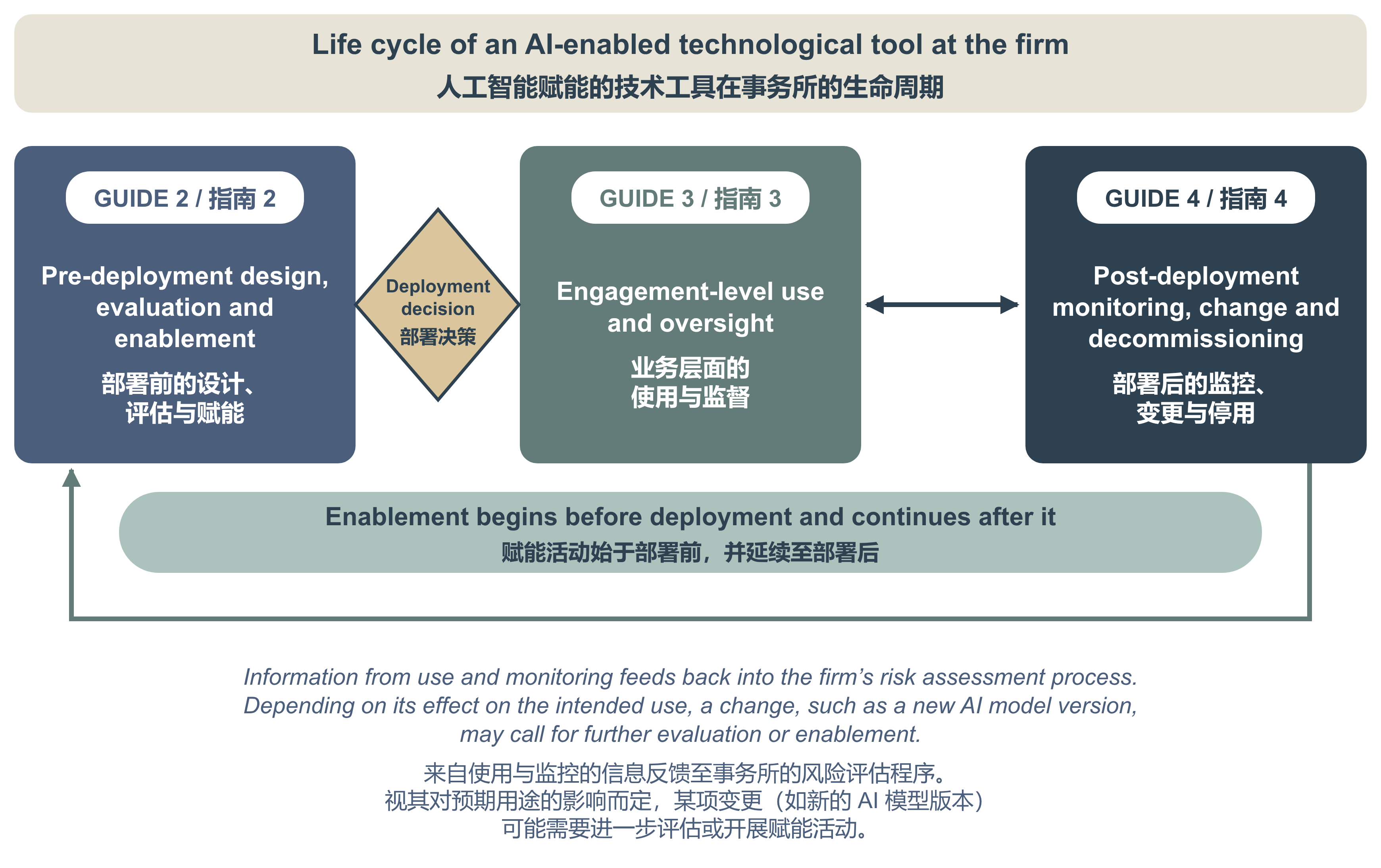
29.As the figure shows, engagement-level use and post-deployment monitoring take place at the same time and inform each other, and information arising from them may require the firm to revisit its earlier understanding of the tool, or an earlier risk assessment, response or decision. The activities within each phase are also not necessarily sequential and may overlap. For example, design, configuration, evaluation, methodology development and enablement may occur together.
29.如图所示,业务层面的使用与部署后的监控同时进行,并相互提供信息。由此产生的信息可能要求事务所重新审视先前对该工具的了解,或先前的风险评估、应对措施或决策。各阶段内的活动也不一定依次开展,可能相互重叠。例如,设计、配置、评估、方法论开发与赋能活动可能同时进行。
30.The table below summarizes the primary focus of each phase and the guide that principally addresses it.
30.下表概述了各个阶段的主要关注重点以及主要阐述该阶段的相应指南:
| Life Cycle Phase / 生命周期阶段 | Primary Focus / 主要关注重点 | Principal Guide / 主要指南 |
|---|---|---|
| Pre-deployment design, evaluation and enablement 部署前设计、评估与赋能 |
Identify and assess quality risks for the intended use or category of use, and design and implement responses, that is, policies or procedures to address the assessed quality risks, including those applied at the engagement level. Responses before deployment include, where applicable, designing or configuring relevant elements of the tool; evaluating the tool, including by testing it, to obtain a sufficient basis to determine whether and how it may be made available; and preparing personnel, methodology and the operating environment for use.
针对预期用途或使用类别识别并评估质量风险,设计并实施应对措施(即针对评估的质量风险采取的政策或程序,包括在业务层面应用的政策或程序)。部署前的应对措施(视适用情况而定)包括:设计或配置工具的相关组成要素;对工具进行评估(包括测试),以获取充分依据确定是否以及如何提供该工具;以及为工具的使用做好人员、方法论和运行环境的准备。 |
Guide 2 (指南 2) |
| Engagement-level use and oversight 业务层面的使用与监督 |
Apply the firm’s policies or procedures in the circumstances of the engagement; direct, supervise and review the work; evaluate the tool’s outputs or actions; and communicate relevant information from the engagement to the firm and, where applicable, its network.
在业务的具体情况下应用事务所的政策或程序;指导、监督并复核工作;评估工具的输出或行为;并向事务所(及适用时的所属网络)沟通反馈来自业务的相关信息。 |
Guide 3 (指南 3) |
| Post-deployment monitoring, change and decommissioning 部署后的监控、变更与停用 |
Monitor information about performance, use, incidents and changes and, through the firm’s monitoring and remediation process, the responses relating to the tool; remediate identified deficiencies; determine whether earlier assessments, decisions or responses need to be revisited; update enablement, such as guidance and training, as needed; and, when appropriate, retire, replace, restrict or suspend the tool or particular functionality and address access, information, communication and transition matters.
监控有关运行表现、使用情况、事件和变更的信息,并通过事务所的监控与整改程序监控与该工具有关的应对措施;整改已识别的缺陷;确定是否需要重新审视先前的评估、决策或应对措施;根据需要更新指导和培训等赋能活动;在适当时停用、替换、限制或暂停工具或特定功能,并处理访问、信息、沟通和过渡事项。 |
Guide 4 (指南 4) |
31.Certain matters apply across all phases and are addressed in each guide as relevant. These include the components of the SOQM, as well as matters such as human involvement; roles, responsibilities and authority; competence and capabilities; data and knowledge; privacy and confidentiality; documentation and traceability; scalability; and feedback loops.
31.某些事项适用于所有阶段,并在各指南的相关部分中予以阐述。这些事项包括质量管理体系的组成要素,以及人员参与、角色、责任与权限、专业胜任能力与素质、数据与知识、隐私与保密性、文档记录与可追溯性、可扩展性以及反馈回路等事项。
32.The guide series uses examples to illustrate how the concepts and principles in Guide 1 may be applied at different phases of the life cycle. The examples are not exhaustive and do not establish expectations for how a firm designs its SOQM.
32.本指南系列采用示例说明指南 1 中的概念和原则可能如何应用于生命周期的不同阶段。这些示例并非穷尽性的,也不对事务所如何设计其质量管理体系确立预期。
33.The life cycle provides navigation, not a required way for firms to organize their governance, technology or quality management activities. A firm may use different terminology or combine activities, provided that its SOQM meets the requirements of ISQM 1.
33.生命周期提供的是导引路径,而非强制要求事务所组织其治理、技术或质量管理活动的方式。事务所只要其质量管理体系符合 ISQM 1 的要求,完全可以使用不同的术语或整合各项活动。
4.Applying the Firm’s Risk Assessment Process / 4.应用事务所的风险评估程序
4.1 How the Firm’s Risk Assessment Process Applies / 4.1 事务所风险评估程序如何适用
34.The firm’s risk assessment process as outlined in ISQM 119 is fundamental to the quality management of AI-enabled technological tools.
34.ISQM 1 中概述的事务所风险评估程序19,是人工智能赋能的技术工具质量管理的基础。
Key ISQM 1 Concepts Used in the Guide Series / 本指南系列中使用的 ISQM 1 核心概念
The following ISQM 1 concepts are used throughout the guide series. They are stated here with close reference to ISQM 1.
下列 ISQM 1 核心概念贯穿于整个指南系列。在此紧密参照 ISQM 1 原文进行阐述:Quality objectives / 质量目标
Quality objectives are the desired outcomes in relation to the components of the SOQM. ISQM 1 requires the firm to establish the quality objectives it specifies and any additional quality objectives the firm considers necessary to achieve the objectives of its SOQM. A firm may also establish sub-objectives to enhance its identification and assessment of quality risks and its design and implementation of responses.20
The nature and circumstances of the firm and its engagements may be such that the firm may not find it necessary to establish additional quality objectives.21 However, a firm may determine the need to establish additional quality objectives in its circumstances.
质量目标是针对质量管理体系各组成要素所期望达到的成果。ISQM 1 要求事务所确立准则所规定的质量目标,以及事务所认为实现质量管理体系目标所必需的任何额外质量目标。事务所亦可设立子目标,以强化对质量风险的识别与评估,以及应对措施的设计与实施。20
事务所及其业务的性质和具体情况可能表明,事务所认为没有必要确立额外的质量目标。21然而,事务所可以根据自身情况确定确立额外质量目标的必要性。Quality risks / 质量风险
A risk arises from how, and the degree to which, a condition, event, circumstance, action or inaction may adversely affect the achievement of a quality objective.22 Put simply, identifying and assessing quality risks focuses on what could go wrong in achieving the quality objectives.23 Not every risk is a quality risk. A quality risk is a risk that has a reasonable possibility of both occurring and, individually or in combination with other risks, adversely affecting the achievement of one or more quality objectives. The firm exercises professional judgment in determining whether a risk meets that threshold.24
How the firm expresses its quality risks, including how specific they are, is a matter for the firm.25 The guide series therefore does not set out quality risks. Instead, where it addresses the firm’s risk assessment process, it describes what could go wrong. Considering what could go wrong is not a separate step. It is an aid to help the firm identify and assess quality risks that reflect the nature and circumstances of the firm and its engagements, or recognize when the reasons for the assessment of a quality risk it has already identified have changed.
风险产生于某种条件、事件、情形、作为或不作为如何以及在多大程度上可能对质量目标的实现产生不利影响。22简而言之,识别和评估质量风险聚焦于在实现质量目标的过程中“可能发生什么差错”(what could go wrong)。23并非每项风险都属于质量风险。质量风险是指合理可能发生,且单项或与其他风险汇总起来合理可能对一项或多项质量目标的实现产生不利影响的风险。事务所在确定某项风险是否达到该门槛时应运用职业判断。24
事务所如何表述其质量风险(包括具体程度),由事务所决定。25因此,本指南系列不列示质量风险。相反,在探讨事务所风险评估程序时,指南描述了“可能发生什么差错”。思考可能发生什么差错并非一个独立的步骤,而是协助事务所识别和评估能够反映事务所及其业务性质和具体情况的质量风险,或识别先前已识别的质量风险的评估理由何时发生变化的辅助手段。Responses / 应对措施
Responses are policies or procedures designed and implemented by the firm to address one or more quality risks.26 ISQM 1 requires the firm to identify and assess quality risks to provide a basis for the design and implementation of responses. Responses are designed and implemented in a manner that is based on, and responsive to, the reasons for the assessments given to those quality risks, that is, their considered occurrence and effect on the achievement of one or more quality objectives.27 In other words, a response is designed to address why the quality risk was assessed as it was. In this guide series, references to responses that address quality risks carry this meaning. The figure below illustrates how these concepts relate.
应对措施是指事务所为应对一项或多项质量风险而设计和实施的政策或程序。26 ISQM 1 要求事务所识别并评估质量风险,以便为应对措施的设计和实施提供基础。应对措施的设计和实施,应当基于针对这些质量风险给出的评估理由并做出积极应对——即考虑其发生的可能性以及对实现一项或多项质量目标的影响。27换言之,设计应对措施旨在解决该项质量风险“为何会被如此评估”的原因。在本指南系列中,提及应对质量风险的措施均具有此涵义。下图展示了这些概念之间的关系。
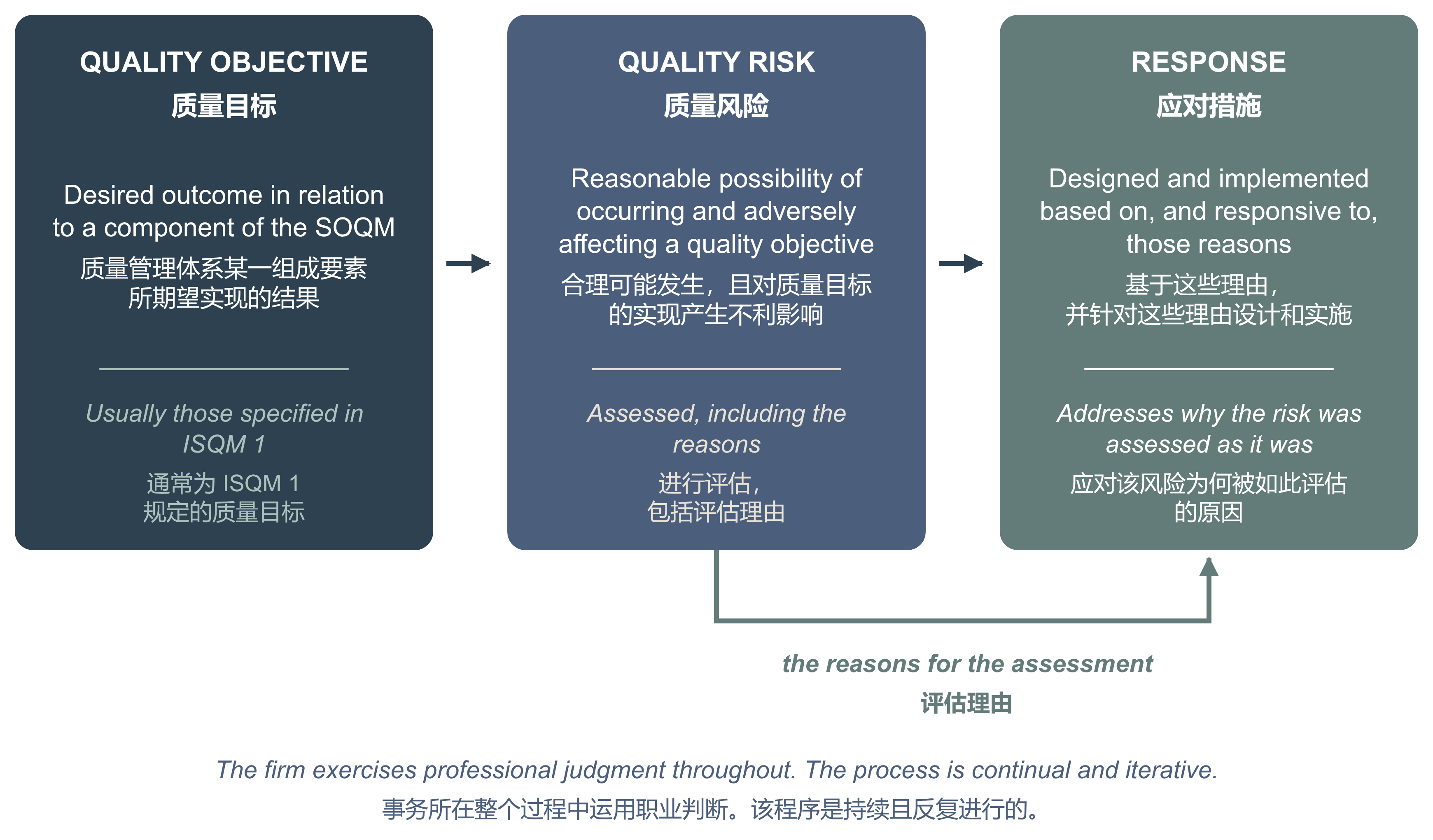
35.The firm’s existing quality objectives, quality risks and responses may already encompass an intended use or category of use of an AI-enabled technological tool. In that case, no further quality risks need to be identified. In other cases, the use may lead the firm to identify a new quality risk, modify an existing one or reconsider the reasons for the assessment of an existing one (see Section 4.3).28 Each tool is considered in the context of its intended use or category of use, but this does not mean that each tool gives rise to quality risks of its own. Several tools may be considered together because of the nature and characteristics of their intended uses. Therefore, a quality risk may relate to several tools, depending on their intended uses and the firm’s consideration of the risk assessment considerations described in Section 4.2.
35.事务所现有的质量目标、质量风险及应对措施可能已经涵盖了人工智能赋能的技术工具的某种预期用途或使用类别。在此情况下,无需识别额外的质量风险。在其他情况下,该使用可能促使事务所识别出新的质量风险、修改现有风险或重新考量现有风险的评估理由(参见第 4.3 节)。28每个工具都是在其预期用途或使用类别的背景下进行考量的,但这并不意味着每个工具都会产生其特有的独立质量风险。鉴于其预期用途的性质和特征,多个工具可以合并进行考量。因此,一项质量风险可能与多个工具有关,这取决于其预期用途以及事务所对第 4.2 节中风险评估考量因素的综合权衡。
36.A firm that belongs to a network may use an assessment performed by the network, for example for a tool the network makes available to its member firms. The firm remains responsible for determining how network requirements or network services are relevant to, and are taken into account in, its SOQM, and whether they need to be adapted or supplemented, for example for jurisdictional matters.29
36.属于某一网络的事务所,可以使用该网络执行的评估,例如针对网络向成员所提供的工具所执行的评估。事务所仍有责任确定网络要求或网络服务如何与其质量管理体系相关,以及如何将其考虑在内,并确定是否需要进行调整或补充,例如针对司法管辖区相关事项。29
37.Engagement teams do not repeat the firm’s risk assessment process. They apply the firm’s responses to quality risks, that is, its policies or procedures, in the circumstances of the engagement. However, a firm cannot identify all quality risks that may arise at the engagement level or set forth all relevant and appropriate responses. For audits of financial statements, ISA 220 (Revised) recognizes that the engagement team, led by the engagement partner, is responsible for determining whether to design and implement responses at the engagement level beyond the firm’s policies or procedures.30
37.业务团队不重复执行事务所的风险评估程序,而是在业务的具体情况下应用事务所对质量风险的应对措施,即事务所的政策或程序。然而,事务所无法识别业务层面可能出现的所有质量风险,也无法列示所有相关且恰当的应对措施。对于财务报表审计,ISA 220(修订版)指出,由项目合伙人领导的业务团队负责确定,是否在事务所的政策或程序之外,在业务层面设计并实施应对措施。30
38.The figure below illustrates how a firm may consider an AI-enabled technological tool when identifying and assessing quality risks. The intended use or category of use is at the center, because it provides the context for understanding the tool and what could go wrong in achieving the quality objectives. Around it are the risk assessment considerations, framed as questions.
38.下图展示了事务所在识别和评估质量风险时如何考量人工智能赋能的技术工具。预期用途或使用类别处于核心位置,因为它为理解该工具以及在实现质量目标中可能发生什么差错提供了具体语境。环绕在其周围的是以提问形式呈现的各项风险评估考量因素。

39.For an AI-enabled technological tool designed for a clearly defined purpose, the intended use may be described with relative precision. A tool with broader functionality may support many uses. In that case, the firm may identify reasonably foreseeable categories of use. For example, for a general-purpose AI application, the firm may be able to describe broad categories of use, such as extracting and analyzing information from source documents or identifying items for further investigation. Where relevant, the firm may also describe uses that are not permitted. Uses may be considered together as a category where the firm concludes that they give rise to the same quality risks, for the same reasons, and so can be addressed by the same responses.31 New or expanded uses may require further application of the firm’s risk assessment process.
39.对于针对明确界定的目的而设计的人工智能赋能的技术工具,其预期用途可以进行相对精确的描述。功能更为广泛的工具可能支持多种用途。在这种情况下,事务所可以识别合理可预见的使用类别。例如,对于通用 AI 应用程序,事务所可以描述广泛的使用类别,例如从原始文档中提取并分析信息,或识别需要进一步调查的项目。在相关情况下,事务所还可以明确说明不允许的使用方式。若事务所认定多项使用方式由于相同的原因产生相同的质量风险,且可以通过相同的应对措施予以解决,则可将其合并为一个类别进行考量。31新增或扩大的用途可能需要进一步应用事务所的风险评估程序。
4.2 Risk Assessment Considerations for an AI-Enabled Technological Tool / 4.2 人工智能赋能的技术工具的风险评估考量因素
40.The risk assessment considerations, introduced as questions in the figure in Section 4.1, help the firm understand an AI-enabled technological tool and its intended use or category of use, and think through what could go wrong in achieving the quality objectives. They are explained in more detail below to illustrate why they may be relevant when the firm identifies and assesses quality risks. The considerations are not a separate risk framework, an exhaustive list or a mandatory checklist. The firm is not expected to address or document each consideration separately. Their relevance and relative importance vary with the circumstances, and they are applied together. In the text, a consideration is marked with its numbered icon, for example ⑤ for how significant a tool’s outputs or actions are.
40.第 4.1 节图示中以提问形式引入的风险评估考量因素,有助于事务所理解人工智能赋能的技术工具及其预期用途或使用类别,并思考在实现质量目标中可能发生什么差错。下文对这些考量因素作进一步说明,以阐明其在事务所识别和评估质量风险时为何可能具有相关性。这些考量因素并非独立的风险框架、穷尽性清单或强制性核对表,并不要求事务所单独处理或记录每项考量因素。它们的相关性和相对重要程度随具体情况而异,应结合运用。在正文中,各项考量因素以带编号的图标标示,例如以 ⑤ 表示工具的输出或行为有多重要。
① Consideration 1: What Can the Tool Do and How Does It Behave? / ① 考量因素 1:该工具有何能力?其运行表现如何?
41.The tool’s functionality, and the extent to which it exhibits relevant AI characteristics, may affect what could go wrong in achieving the quality objectives. The firm may consider, for example:
- The functionality made available by the tool, including relevant functionality beyond the intended use or category of use; and
- The extent to which that functionality exhibits opacity, probabilistic behavior, adaptivity and autonomy.
41.工具所提供的功能以及其表现出相关 AI 特征的程度,可能会影响在实现质量目标中可能发生什么差错。事务所可以考量例如:
- 工具所提供的具体功能,包括超出预期用途或使用类别的相关附加功能;
- 该功能表现出不透明性(opacity)、概率性行为(probabilistic behavior)、自适应性(adaptivity)和自主性(autonomy)的程度。
42.Not every tool exhibits every characteristic, and a tool may combine deterministic functionality with functionality that exhibits probabilistic behavior. Characteristics are not binary. A tool may exhibit a characteristic to a greater or lesser degree. The list is not exhaustive; other characteristics may also be relevant depending on the tool, its intended use or category of use and the surrounding circumstances.32 The table below explains why each may matter for quality management.
42.并非每个工具都表现出每种特征,而且工具可能将确定性功能与表现出概率性行为的功能结合在一起。这些特征并非非此即彼,工具可能表现出程度不同的某种特征。上述清单并非穷尽性的;根据工具、其预期用途或使用类别以及周边具体情况,其他特征也可能相关。32下表说明了各项特征为何可能与质量管理有关。
| Core Characteristic / 核心特征 | Why It May Matter for Quality Management / 为何可能与质量管理有关 |
|---|---|
| Opacity 不透明性 |
It may be harder to test the tool, to evaluate or challenge its outputs or actions, and to investigate unexpected behavior. It may also be harder to document or explain how the tool contributed to the engagement work.
对工具进行测试、评估或质疑其输出或行为,以及调查非预期运行表现的难度可能会增加。此外,记录或解释该工具如何对业务工作做出贡献的难度也可能加大。 |
| Probabilistic behavior 概率性行为 |
It may be harder to set criteria for judging whether the tool performs as intended, to repeat results and to test the tool. Outputs may also appear plausible but be inaccurate, incomplete or unsupported, for example because information is omitted, misclassified or incorrectly extracted, or because content is fabricated (sometimes referred to as hallucinations).
确定判断工具是否按预期运行的评价标准、复现运行结果以及测试工具的难度可能会加大。输出结果可能看似合理但实际上不准确、不完整或缺乏依据,例如由于信息被遗漏、错误分类或提取不当,或者内容纯属捏造(有时被称为“幻觉”/ hallucinations)。 |
| Adaptivity 自适应性 |
Outputs or actions may become less predictable over time. Earlier evaluation and approval may no longer remain relevant.
随着时间的推移,输出或行为的可预测性可能降低。先前的评估和批准可能不再相关。 |
| Autonomy 自主性 |
Actions may occur without an individual directing each step. Authorization, intervention points, logging, exception handling and the ability to reverse actions may therefore become more important.
行为可能在没有人员逐步指导的情况下发生。因此,授权、干预节点、日志记录、异常处理以及撤销行为的能力可能变得更加重要。 |
43.A tool may also process large volumes of information quickly, so that an inaccurate output or inappropriate action may be repeated across many items before it is identified, and it may be harder for individuals to review outputs or actions with appropriate care. Outputs that appear plausible may also lead individuals to place too much reliance on them (sometimes referred to as automation bias).
43.工具还可能快速处理大量信息,因此,不准确的输出或不恰当的行为可能在被识别之前就在多个条目中重复发生,人员也可能更难以适当的谨慎程度复核输出或行为。看似合理的输出还可能使人员对其产生过度依赖(有时称为自动化偏差)。
② Consideration 2: Who Develops, Configures and Maintains It, and What Information Is Available? / ② 考量因素 2:由谁开发、配置和维护该工具?有哪些可用信息?
44.Who develops, configures and maintains the tool or relevant elements, and what information the firm has about those activities, may affect how well the firm understands the tool and whether it can change it. Where the firm has limited information about, or control over, these activities, it may be more challenging for the firm to determine whether the tool is appropriate for the intended use or category of use, or to identify when a change affects how the tool performs. The firm may consider, for example:
- Who developed or selected the tool or relevant elements;
- Who configures, tests, maintains and can change the tool or those elements;
- What work is performed by the firm, its network or service providers, including whether different arrangements apply to different elements; and
- What information is available to the firm about those activities and about the tool’s performance and limitations.
44.由谁开发、配置和维护该工具或其相关组成要素,以及事务所掌握有关这些活动的哪些信息,可能会影响事务所对该工具的理解深度以及事务所是否能够对其进行变更。若事务所对这些活动掌握的信息或控制权有限,事务所在确定该工具是否适合预期用途或使用类别,或在识别某项变更何时会影响工具的运行表现时,可能会面临更大的挑战。事务所可以考量例如:
- 由谁开发或选定该工具或相关组成要素;
- 由谁配置、测试、维护该工具或这些组成要素,以及谁能够对其进行变更;
- 事务所、其网络或服务提供商各自执行哪些工作,包括不同组成要素是否适用不同安排;
- 事务所能够获取关于这些活动以及该工具运行表现和局限性的哪些信息。
③ Consideration 3: How Is It Accessed and What Information Does It Use? / ③ 考量因素 3:如何访问该工具?它使用何种信息?
45.How the tool is accessed and hosted, how information flows, and what information it uses may affect confidentiality and the reliability of its outputs. For example, confidential information may be retained or used for purposes the firm did not intend or that have not been authorized, or outputs may be based on information that is incomplete, outdated or unsuitable for the intended use or category of use. The firm may consider, for example:
- How the tool is accessed and hosted;
- Where information is received, processed, stored or accessed and by whom;
- The nature, provenance, quality and sensitivity of information used to train, ground or operate the tool, or information retrieved for the tool;
- The applicable data-use, retention, privacy, confidentiality and security arrangements, including for cybersecurity; and
- Legal and regulatory requirements that apply to the use of the tool or to the information it uses, such as requirements relating to AI, data protection or where information may be stored or processed.
45.工具的访问和托管方式、信息如何流转以及其使用何种信息,可能影响保密性及输出的可靠性。例如,保密信息可能被留存,或用于事务所未曾预期或未经授权的目的;输出也可能基于不完整、过时或不适合预期用途或使用类别的信息。事务所可以考量例如:
- 工具的访问和托管方式;
- 信息在何处被接收、处理、存储或访问,以及由谁进行上述操作;
- 用于训练该工具、为其提供依据或使其运行的信息,或为该工具检索的信息的性质、来源、质量和敏感程度;
- 适用的数据使用、留存、隐私保护、保密性与安全安排(包括网络安全防护);
- 适用于工具使用或其所使用信息的法律法规要求,例如与人工智能、数据保护或信息可存储、处理的地点有关的要求。
④ Consideration 4: How Much Flexibility Do Users Have in How the Tool Is Used? / ④ 考量因素 4:用户在使用该工具时拥有多大灵活性?
46.The more discretion users have in how the tool is used, the harder it may be for the firm to anticipate how it will be used and whether its evaluation of the tool and its other responses address those uses. The firm may consider, for example:
- Whether the firm defines centrally how the tool is used or leaves engagement teams to determine this, for example by writing their own prompts, adjusting settings, adding knowledge sources or building their own agents or workflows;
- The extent to which the quality of outputs or actions depends on those choices and on users’ skills; and
- Whether the firm can identify use of the tool beyond the intended use or category of use, for example through its monitoring activities.
46.用户在工具使用方式上拥有的自由裁量权越大,事务所可能越难预判工具将如何使用,以及其对工具的评估和其他应对措施是否涵盖这些用途。事务所可以考量例如:
- 事务所是集中界定工具的使用方式,还是交由业务团队决定,例如自行编写提示词、调整设置、添加知识源,或构建自己的智能体或工作流程;
- 输出或行为的质量在多大程度上取决于这些自主选择以及用户的技能水平;
- 事务所能否识别超出预期用途或使用类别的工具使用,例如通过其监控活动。
⑤ Consideration 5: How Significant Are Its Outputs or Actions? / ⑤ 考量因素 5:其输出或行为的重要性程度如何?
47.The more the tool’s outputs or actions contribute to the work performed on the engagement, the greater the potential effect if they are inappropriate. The firm may consider, for example:
- How outputs or actions may affect engagement procedures, evidence, professional judgments, conclusions or documentation; and
- The degree to which the results of an engagement procedure depend on the tool’s outputs or actions, and the relative importance of the evidence from that procedure.33
47.工具的输出或行为对业务中所执行工作的贡献越大,在其不恰当时可能产生的影响就越大。事务所可以考量例如:
- 输出或行为可能如何影响业务程序、证据、职业判断、结论或业务工作底稿;
- 某项业务程序的结果在多大程度上依赖于该工具的输出或行为,以及来自该程序的证据的相对重要程度。33
⑥ Consideration 6: Can Outputs or Actions Be Evaluated, Challenged or Overridden? / ⑥ 考量因素 6:其输出或行为能否被评估、质疑或推翻?
48.The capacity to evaluate outputs or actions, and the human involvement contemplated, may affect whether inappropriate outputs or actions are identified and addressed before they affect the engagement. The firm may consider, for example:
- Whether outputs or actions can feasibly be traced to reliable source information, reproduced, corroborated or otherwise evaluated, including whether inaccurate, incomplete or unsupported outputs, particularly omissions, are likely to be detected;
- Whether individuals can challenge outputs, override or reverse actions or otherwise intervene when needed; and
- The nature and extent of human involvement contemplated, including whether it is reasonably capable of addressing the matter it is intended to address (see Section 2.1).
48.评估输出或行为的能力以及所设想的人员参与,可能影响不恰当的输出或行为能否在影响业务之前被识别并加以处理。事务所可以考量例如:
- 输出或行为是否能够切实追溯至可靠的原始信息,能否被复现、印证或以其他方式评估,包括不准确、不完整或缺乏依据的输出(尤其是遗漏事项)是否较有可能被发现;
- 人员在需要时能否质疑输出、推翻或撤销行为,或以其他方式进行干预;
- 所设想的人员参与的性质和范围,包括该参与是否能够合理应对其旨在应对的事项(参见第 2.1 节)。
⑦ Consideration 7: How Broadly Will It Be Used? / ⑦ 考量因素 7:该工具的使用范围有多广?
49.The more broadly the tool is used, the more engagements may be affected if it does not perform as intended, for example because of a configuration error or a change in the AI model it uses, before this is identified. The firm may consider, for example:
- The number and types of users, engagements and jurisdictions;
- The range of permitted or reasonably foreseeable uses; and
- The extent to which the tool is connected to other systems or tools, such as the firm’s engagement software or document repositories, through which its outputs or actions may reach other engagement work.
49.工具的使用范围越广,若其未按预期运行,例如由于配置错误或所使用的 AI 模型发生变更,在问题被识别之前可能受到影响的业务就越多。事务所可以考量例如:
- 使用人员、业务项目以及涉及司法管辖区的数量和类型;
- 允许的或合理可预见的使用场景范围;
- 该工具与其他系统或工具的连接程度,例如事务所的业务软件或文档库;其输出或行为可能通过这些系统或工具传递至其他业务工作。
Applying the Considerations Together / 综合运用各项考量因素
50.The considerations are not sequential, and no single consideration by itself determines whether a quality risk exists or how it is assessed. For example, a summarization tool may produce outputs that can be readily compared with source information ⑥, but the same use may still give rise to quality risks if confidential engagement information is sent outside the firm without the firm understanding how that information is stored, used or protected ③. Conversely, strong controls over access to the tool and the information it uses ③ do not, by themselves, address quality risks relating to outputs that significantly influence professional judgments and are difficult to evaluate ⑤⑥.
50.各项考量因素并非按先后顺序排列,任何单一考量因素本身都不能决定是否存在质量风险或如何评估该风险。例如,摘要工具可能生成可方便地与原始信息进行比较的输出 ⑥,但如果保密的业务信息被发送到事务所外部,而事务所并不了解这些信息如何被存储、使用或保护 ③,则同一种使用仍可能引发质量风险。相反,对工具访问权限及其所用信息的有力控制 ③,本身并不能应对与对职业判断具有重大影响且难以评估的输出相关的质量风险 ⑤⑥。
51.The considerations are also interrelated. For example, a firm that develops a tool itself may have more information about how the tool works and how it has been tested ② than a firm that obtains the tool from a service provider. What the firm knows about the tool may, in turn, affect how it approaches the other considerations, such as understanding what the tool can do and how it behaves ① and how information flows through it ③.
51.各项考量因素也相互关联。例如,与从服务提供商处获取工具的事务所相比,自行开发工具的事务所可能掌握更多关于该工具如何运行及如何进行测试的信息 ②。事务所对该工具的了解,反过来也可能影响其处理其他考量因素的方式,例如理解该工具有何能力及其运行表现 ①,以及信息如何在其中流转 ③。
4.3 Identifying and Assessing Quality Risks / 4.3 识别和评估质量风险
52.The firm identifies and assesses quality risks in accordance with ISQM 1.34 For an AI-enabled technological tool, the firm uses its understanding of the tool, the intended use or category of use and the relevant circumstances, informed by the risk assessment considerations in Section 4.2, to think through what could go wrong, which quality objectives may be affected, and why. Thinking through what could go wrong is not a separate step but an aid to identifying and assessing quality risks. It informs both whether a quality risk exists and the reasons for the firm’s assessment of it.
52.事务所按照 ISQM 1 的规定识别并评估质量风险。34对于人工智能赋能的技术工具,事务所参考第 4.2 节的风险评估考量因素,运用对工具、预期用途或使用类别以及相关具体情况的了解,思考可能发生什么差错、哪些质量目标可能受到影响以及原因何在。思考可能发生什么差错并非一个独立的步骤,而是协助识别和评估质量风险的手段。这既有助于判断是否存在质量风险,也有助于确定事务所对该风险的评估理由。
53.The risk assessment considerations may show that the reasons for the assessment of a quality risk the firm has already identified have changed. The responses may then need to change, even though the quality risk itself is unchanged.35 For example, the firm may already have identified a quality risk relating to the quality objective on technological resources.36 For a tool that extracts terms from contracts, the considerations may reveal that the tool could omit non-standard terms without indicating that it has done so ①, and that engagement team members reviewing its outputs may not see what was missed ⑥. The quality risk may be unchanged, but these reasons may call for specific responses, such as testing the tool with contracts containing known non-standard terms.
53.风险评估考量因素可能表明,事务所先前识别出的某项质量风险的评估理由已经发生变化。即使质量风险本身没有改变,应对措施也可能需要调整。35例如,事务所可能已经识别出与技术资源质量目标相关的一项质量风险。36对于从合同中提取条款的工具,这些考量因素可能揭示,该工具可能遗漏非标准条款而未予提示 ①,且复核输出的业务团队成员可能无法发现遗漏的内容 ⑥。质量风险可能保持不变,但这些理由可能要求采取具体的应对措施,例如使用包含已知非标准条款的合同测试该工具。
54.The firm identifies and assesses quality risks before designing the responses to address them.37 Having a policy or procedure in place that may already address a quality risk, such as one requiring engagement team members to review a tool’s outputs, does not remove the need to identify and assess that quality risk. Understanding what could go wrong, and why, helps the firm judge whether that policy or procedure is enough. For example, reviewing outputs may not reveal information the tool has left out.
54.事务所在设计应对质量风险的措施之前,先识别并评估这些风险。37已经存在某项可能应对质量风险的政策或程序,例如要求业务团队成员复核工具输出的政策,并不免除识别和评估该质量风险的必要性。了解可能发生什么差错及其原因,有助于事务所判断该政策或程序是否充分。例如,复核输出可能无法发现工具遗漏的信息。
55.ISQM 1 requires the firm to document its quality objectives and quality risks and to describe the responses and how those responses address the quality risks.38 It does not require the firm to document everything it considered in identifying them. The firm may, however, document the reasons for its assessment of a quality risk, which reflect what could go wrong, to support the consistent implementation and operation of the responses.39 Guide 2 illustrates what firm-level documentation relating to an AI-enabled technological tool may include.
55.ISQM 1 要求事务所记录其质量目标和质量风险,并描述应对措施以及这些措施如何应对质量风险。38准则并不要求事务所记录在识别过程中所考量的所有事项。然而,事务所可以记录其评估某项质量风险的理由,这些理由反映了可能发生什么差错,以支持应对措施的一致实施和运行。39指南 2 说明了与人工智能赋能的技术工具相关的事务所层面文档记录可能包括哪些内容。
4.4 Designing and Implementing Responses to Address the Quality Risks / 4.4 设计和实施应对质量风险的措施
56.Responses relating to an AI-enabled technological tool may operate at different points in its life cycle, for example in how the tool is designed, evaluated and approved before deployment (Guide 2), in how engagement teams use and oversee it, including through human involvement (Guide 3), and in how the firm monitors it after deployment (Guide 4). Guide 4 also addresses how the firm’s monitoring and remediation process applies to those responses.
56.与人工智能赋能的技术工具相关的应对措施可以在其生命周期的不同节点发挥作用,例如体现在部署前如何对工具进行设计、评估与批准(指南 2),体现在业务团队如何使用和监督该工具(包括通过人员参与)(指南 3),以及体现在事务所如何在部署后对其进行监控(指南 4)。指南 4 还阐述了事务所的监控与整改程序如何适用于这些应对措施。
57.When a general-purpose AI application or other tool with broad functionality is made available, it may be impracticable to anticipate every individual use or to list every permitted and prohibited use. This is particularly likely where users have discretion in how the tool is used ④.
57.当提供通用 AI 应用程序或其他具有广泛功能的工具时,预先判断每一种具体用途,或列出每一项允许和禁止的用途,可能并不切实可行。在用户可自行决定工具使用方式的情况下 ④,尤其可能如此。
58.In such cases, the firm may instead describe broad categories of use and, where relevant, uses that are not permitted (see Section 4.1), and set the conditions on which the tool is made available (approval conditions). These may include principles-based boundaries, supported as appropriate by guidance and training, consultation or escalation, controls built into the tool or into how it is accessed, and monitoring. Approval conditions are one type of response and do not necessarily require a separate approval for each use. Guide 2 explains approval conditions in more detail.
58.在此类情况下,事务所可以转而描述广泛的使用类别,并在相关情况下描述不允许的用途(参见第 4.1 节),同时设定提供该工具的条件(批准条件)。这些条件可以包括以原则为基础的边界,并视情况辅以指导和培训、咨询或上报、嵌入工具或其访问方式中的控制措施,以及监控。批准条件是应对措施的一种,并不一定要求对每次使用单独批准。指南 2 对批准条件作了进一步说明。
59.The responses available to a firm may also vary depending on how the tool is developed, provided or controlled and on the information available to the firm. For example, when a tool, or parts of it, are obtained from a service provider, the firm may have limited information about, or ability to influence, aspects of the service. Such limitations do not change the quality objectives the firm is required to achieve, but may affect the responses available and whether the firm can obtain a sufficient basis for its decision to make the tool or particular functionality available for particular uses, users or circumstances.
59.事务所可采取的应对措施,也可能因工具的开发、提供或控制方式以及事务所掌握的信息而有所不同。例如,当工具或其部分组成来自服务提供商时,事务所对该服务某些方面掌握的信息或施加影响的能力可能有限。此类局限性不会改变事务所需要实现的质量目标,但可能影响可采取的应对措施,以及事务所能否获取充分依据,支持其针对特定用途、用户或情形提供该工具或特定功能的决策。
4.5 Revisiting the Assessment / 4.5 重新审视风险评估
60.ISQM 1 requires the firm to establish policies or procedures designed to identify information indicating that additional quality objectives, or additional or modified quality risks or responses, are needed.40 For an AI-enabled technological tool, such information may arise at any phase of the life cycle described in Section 3, for example:
- Before deployment, from evaluating and testing the tool (Guide 2);
- During use, from engagement teams’ experience with the tool and relevant information they communicate to the firm (Guide 3); and
- After deployment, from monitoring the tool, from the firm’s monitoring and remediation process as it applies to the responses relating to the tool, and from incidents and changes, including changes communicated by a network or service provider (Guide 4).
Information may also arise from new or expanded uses, or from changes in the nature and circumstances of the firm or its engagements. The figure below illustrates this.
60.ISQM 1 要求事务所建立相关政策或程序,旨在识别表明需要确立额外质量目标,或者需要新增或修改质量风险或应对措施的信息。40对于人工智能赋能的技术工具,此类信息可能出现在第 3 节所述生命周期的任何阶段,例如:
- 部署前:源自对工具的评估和测试(指南 2);
- 使用期间:源自业务团队使用该工具的实践经验以及向事务所反馈沟通的相关信息(指南 3);
- 部署后:来自对工具的监控、适用于工具相关应对措施的事务所监控与整改程序,以及事件和变更,包括网络或服务提供商沟通的变更(指南 4)。
信息还可能源自新增或扩大的用途,或源自事务所及其业务性质和具体情况的变化。下图对此进行了说明。

61.Changes to the tool, how it is provided or how it is used may affect whether an earlier assessment and the related responses remain appropriate. Examples include new models or versions, changes to configurations, prompts or knowledge sources, and changes to access or data-use terms. The significance of a change depends on its effect on the tool’s relevant functionality, the intended use or category of use, and the reasons for the assessment of the related quality risks. The risk assessment considerations in Section 4.2 may help the firm judge that effect and whether the change calls for revisiting the assessment. How a service provider labels a change does not, by itself, determine its significance.
61.工具、其提供方式或使用方式的变更,可能影响先前评估和相关应对措施是否仍然恰当。例如,新的模型或版本,配置、提示词或知识源的变更,以及访问条件或数据使用条款的变更。变更的重要程度取决于其对工具相关功能、预期用途或使用类别,以及相关质量风险评估理由的影响。第 4.2 节的风险评估考量因素可能有助于事务所判断这种影响,以及变更是否需要重新审视评估。服务提供商对变更的命名本身,并不决定该变更的重要程度。
Appendix 1: Illustrative Examples: Scope of the Guide Series / 附录 1:说明性示例:指南系列的适用范围
Technological resources used directly by engagement teams may serve multiple purposes. An AI-enabled technological resource is an AI-enabled technological tool only when it is used to facilitate the design or performance of an engagement procedure in obtaining evidence (see paragraph 1 of the Introduction to the Guide Series). The following examples illustrate whether a particular use of an AI-enabled technological resource is within the scope of the guide series (see Section 1). They are not exhaustive. A use that is outside the scope of the guide series may nonetheless give rise to quality risks that the firm addresses under ISQM 1, and ISA 220 (Revised) continues to apply.
由业务团队直接使用的技术资源可以服务于多种用途。人工智能赋能的技术资源,唯有在用于有助于在获取证据时设计或执行业务程序时,才属于人工智能赋能的技术工具(参见《指南系列引言》第 1 段)。下列示例说明了对人工智能赋能的技术资源的某项特定使用是否属于本指南系列的适用范围(参见第 1 节)。这些示例并非穷尽性的。不属于本指南系列范围的使用,仍可能引发事务所根据 ISQM 1 应当应对的质量风险,且 ISA 220(修订版)仍然持续适用。
| Illustrative Use of an AI-Enabled Technological Resource / 人工智能赋能的技术资源的使用示例 | Within Scope? / 是否在范围内? | Reason / 判定理由 |
|---|---|---|
| Taking minutes of internal engagement-team meetings held to coordinate scheduling, staffing and deadlines.
记录旨在协调日程安排、人员配置和截止日期的业务团队内部会议纪要。 |
No (否) | The use is administrative and does not facilitate the design or performance of an engagement procedure in obtaining evidence.
该用途属于行政管理性质,并不有助于在获取证据时设计或执行业务程序。 |
| Recording and summarizing information obtained during inquiries performed as part of engagement procedures, where engagement team members use the summaries in evaluating the results of those procedures and retain them as part of the engagement documentation.
记录并总结作为业务程序一部分的询问过程中获取的信息,且业务团队成员在评估这些程序的结果时使用这些摘要并将其作为业务工作底稿的一部分予以留存。 |
Yes (是) | The use facilitates the performance of an engagement procedure in obtaining evidence. It may involve the same technology, with the same functionality, as the previous example. The use, rather than the technology, determines whether the guide series applies.
该用途有助于在获取证据时执行业务程序。它可能涉及与前一个示例完全相同的技术和功能。决定本指南系列是否适用的是其具体用途,而非技术本身。 |
| Analyzing the entity’s financial information, industry benchmarks and external sources such as news reports, to identify unusual trends or relationships and to identify and assess risks of material misstatement.
分析实体的财务信息、行业基准数据以及新闻报道等外部来源,以识别异常趋势或关系,并识别和评估重大错报风险。 |
Yes (是) | The use facilitates the performance of risk assessment procedures in obtaining evidence.
该用途有助于在获取证据时执行风险评估程序。 |
| Reviewing draft financial statements and identifying potential missing or inconsistent disclosures, for engagement team members to investigate further.
审阅财务报表草案并识别潜在缺失或不一致的披露内容,供业务团队成员作进一步调查。 |
Yes (是) | The use facilitates the performance of an engagement procedure in obtaining evidence.
该用途有助于在获取证据时执行业务程序。 |
Appendix 2: Glossary / 附录 2:术语表
This glossary supports consistent terminology across the guide series and helps readers navigate it. Established definitions are used or adapted where suitable. Other publications on AI may use different terms or descriptions for similar concepts. The final column identifies the principal source or indicates that the description is specific to the IAASB guide series. “Adapted from” indicates that a description is based on a definition in the source cited, with changes, and “informed by” indicates that it draws on concepts in the publications cited.
本术语表支持整个指南系列中术语的一致使用,并帮助读者查阅本系列。在适宜的情况下,采用或改编既有定义。其他有关人工智能的出版物可能对相似概念使用不同的术语或描述。最后一列指明主要来源,或表明该描述专用于 IAASB 指南系列。“改编自”表示该描述基于所引来源中的定义并作了修改;“借鉴”表示其参考了所引出版物中的概念。
| Term / 术语 | Description / 描述 | Principal Source / 主要来源 |
|---|---|---|
| Adaptivity 自适应性 |
The ability of an AI system to adjust its behavior after deployment in response to new data, feedback, interaction or changes in its operating environment.
AI 系统在部署后根据新数据、反馈、交互或其运行环境的变化来调整自身行为的能力。 |
IAASB guide-series description informed by OECD/IOSCO and NIST.41 (IAASB 指南系列的描述,借鉴经合组织/国际证监会组织及美国国家标准与技术研究院) |
| Agentic AI 智能体 AI |
AI systems capable of pursuing goals by making decisions and taking actions with varying degrees of autonomy and human involvement.
能够通过作出决策和采取行动来追求目标,且具有不同程度的自主性和人员参与的 AI 系统。 |
Adapted from the AICPA42 glossary; informed by UK FRC43 and IOSCO. (改编自美国注册会计师协会术语表;借鉴英国财务报告委员会及国际证监会组织) |
| AI-enabled technological tool 人工智能赋能的技术工具 |
A technological resource used directly by an engagement team to facilitate the design or performance of engagement procedures in obtaining evidence and that incorporates, or provides access to, one or more AI systems. An AI-enabled technological tool may be general-purpose, making broad functionality available that supports many uses, or may take the form of a specific application, agent or workflow designed for a defined purpose.
由业务团队直接使用、有助于在获取证据时设计或执行业务程序,并且包含或提供对一个或多个 AI 系统的访问的技术资源。人工智能赋能的技术工具可以是通用型的(提供支持多种用途的广泛功能),也可以是针对特定目的设计的专门应用程序、智能体或工作流程。 |
IAASB guide-series term informed by ISQM 1 and OECD/IOSCO terminology. (IAASB 指南系列术语,借鉴 ISQM 1 及经合组织/国际证监会组织术语) |
| AI model AI 模型 |
A core component of an AI system used to make inferences from inputs to produce outputs. An AI model may be incorporated into, or accessed through, an AI-enabled technological tool.
AI 系统的核心组成部分,用于根据输入进行推理以生成输出。AI 模型可以嵌入人工智能赋能的技术工具中,或通过该工具进行访问。 |
Adapted from the AICPA glossary definition of “model,” based on NIST terminology. (改编自美国注册会计师协会术语表中基于美国国家标准与技术研究院术语的“模型”定义) |
| AI system AI 系统 |
A machine-based system that, for explicit or implicit objectives, infers, from the input it receives, how to generate outputs such as predictions, content, recommendations or decisions that can influence physical or virtual environments. Different AI systems vary in their levels of autonomy and adaptiveness after deployment.
一种基于机器的系统,针对明确或隐含的目标,从其接收的输入中推理出如何生成能够影响物理或虚拟环境的预测、内容、建议或决策等输出。不同的 AI 系统在部署后的自主性和自适应性水平各不相同。 |
Updated 2024 OECD definition.44 (经合组织 2024 年更新版定义) |
| Approval conditions 批准条件 |
Conditions established by the firm governing whether and how an AI-enabled technological tool or particular functionality may be made available or used. They may address the purposes or circumstances of use, information that may be processed, authorized users or configurations, required procedures or human involvement, consultation or escalation, and circumstances requiring further firm-level consideration.
由事务所制定的、用以规范是否以及如何提供或使用人工智能赋能的技术工具或特定功能的条件。它们可以涉及使用目的或情形、可处理的信息类型、经授权的用户或参数配置、必须履行的程序或人员参与要求、咨询或上报机制,以及需要事务所层面进一步考量的情形。 |
IAASB guide-series term. (IAASB 指南系列术语) |
| Arrangement 安排 |
How one or more relevant elements of an AI-enabled technological tool are developed, provided or controlled, including by the firm, its network or an external service provider.
人工智能赋能的技术工具的一个或多个相关组成要素如何开发、提供或控制,包括由事务所、其网络或外部服务提供商进行开发、提供或控制。 |
IAASB guide-series term. (IAASB 指南系列术语) |
| Automation bias 自动化偏差 |
A tendency to favor output generated from automated systems, even when human reasoning or contradictory information raises questions as to whether such output is reliable or fit for purpose.
一种倾向于偏信自动化系统所生成输出的倾向,即便人类理性推理或相反的信息已经对该输出是否可靠或是否符合既定目的提出了质疑。 |
ISA 220 (Revised), paragraph A36. (ISA 220(修订版)第 A36 段) |
| Autonomy 自主性 |
The degree to which an AI system can recommend, initiate, sequence or execute actions without step-by-step human direction.
AI 系统在没有人类逐步指导的情况下能够建议、发起、排列顺序或执行操作的程度。 |
IAASB guide-series description informed by OECD/IOSCO and FRC. (IAASB 指南系列的描述,借鉴经合组织/国际证监会组织及英国财务报告委员会) |
| Deployment 部署 |
The firm’s decision to make an AI-enabled technological tool, particular functionality or a category of use available for engagement use, and the act of making it available. Deployment relates to an intended use or category of use and may be broad or limited, including through a controlled pilot.
事务所就提供人工智能赋能的技术工具、特定功能或某种使用类别供业务使用作出的决策,以及实际提供的行为。部署涉及预期用途或使用类别,其范围可以广泛或有限,也可以通过受控试点进行。 |
IAASB guide-series term. (IAASB 指南系列术语) |
| Deterministic 确定性 |
An algorithm that, given the same inputs, always produces the same outputs. The guide series also applies the term to functionality that behaves in this way.
一种在给定相同输入的情况下,始终产生相同输出的算法。本指南系列也将该术语用于以这种方式运行的功能。 |
Adapted from the AICPA glossary definition of “deterministic algorithm,” based on NIST terminology. (改编自美国注册会计师协会术语表中基于美国国家标准与技术研究院术语的“确定性算法”定义) |
| Element 组成要素 |
A constituent part of an AI-enabled technological tool, such as an application, agent or workflow, AI model, hosting environment or other service.
人工智能赋能的技术工具的组成部分,例如应用程序、智能体或工作流程、AI 模型、托管环境或其他服务。 |
IAASB guide-series term. (IAASB 指南系列术语) |
| Enablement 赋能 |
Activities that prepare personnel, methodology and the operating environment for the use of an AI-enabled technological tool, such as training, guidance, approved prompts or templates, access and communication of known limitations. Enablement takes place before deployment and continues after it as users, uses or the tool change.
为使用人工智能赋能的技术工具做好人员、方法论和运行环境准备的活动,例如培训、指导、经批准的提示词或模板、访问以及对已知局限性的沟通。赋能活动在部署前开展,并在部署后随着用户、用途或工具的变化而持续进行。 |
IAASB guide-series term. (IAASB 指南系列术语) |
| General-purpose AI application 通用 AI 应用程序 |
A user-facing AI-enabled application or environment designed to support a broad range of tasks or uses rather than a single defined purpose.
一种面向用户的人工智能赋能的应用程序或环境,旨在支持广泛的任务或用途,而非单一的明确用途。 |
IAASB guide-series term. (IAASB 指南系列术语) |
| Generative AI 生成式 AI |
AI systems or models that generate content, such as text, images, audio or code, in response to inputs such as prompts, using patterns learned from training data. Large language models are a form of generative AI that interpret and generate text.
利用从训练数据中学到的模式,响应提示词等输入并生成文本、图像、音频或代码等内容的 AI 系统或模型。大语言模型是一种解释并生成文本的生成式 AI。 |
Adapted from UK FRC; informed by NIST. (改编自英国财务报告委员会;借鉴美国国家标准与技术研究院) |
| Intended use or category of use 预期用途或使用类别 |
The purpose for which an AI-enabled technological resource is contemplated or expected to be used, or a grouping of reasonably foreseeable uses that the firm considers together when applying its risk assessment process.
人工智能赋能的技术资源被设想或预期用于的目的,或者事务所在应用其风险评估程序时合并考量的一组合理可预见的用途。 |
IAASB guide-series term. (IAASB 指南系列术语) |
| Knowledge source 知识源 |
A repository, database, methodology, policy, document set or other source from which an AI-enabled technological tool retrieves information to generate or support outputs or actions.
人工智能赋能的技术工具从中检索信息,以生成或支持输出或行为的存储库、数据库、方法论、政策、文档集或其他来源。 |
IAASB guide-series term. (IAASB 指南系列术语) |
| Life cycle (of an AI-enabled technological tool) 生命周期(人工智能赋能的技术工具) |
The phases of an AI-enabled technological tool’s life at the firm, from when the firm obtains or develops it, through its design, configuration and use on engagements, to its eventual decommissioning. The guide series uses the life cycle as a practical navigation structure to organize how the firm’s quality management responsibilities apply at each phase. It is not a separate quality management framework or a prescribed tool-development process.
人工智能赋能的技术工具在事务所经历的各个阶段,从事务所获取或开发该工具,经过设计、配置并在业务中使用,直至最终停用。本指南系列采用生命周期作为实务导引架构,以组织阐述事务所在各个阶段适用的质量管理职责。它并非独立的质量管理框架,亦非规定性的工具开发流程。 |
IAASB guide-series term. (IAASB 指南系列术语) |
| Opacity 不透明性 |
The extent to which the basis for an AI system’s output or action is not visible, traceable or readily understandable to users or other relevant parties.
AI 系统输出或行为的生成依据对用户或其他相关方而言不可见、不可追溯或不易理解的程度。 |
IAASB guide-series description informed by NIST, IOSCO and FRC. (IAASB 指南系列的描述,借鉴美国国家标准与技术研究院、国际证监会组织及英国财务报告委员会) |
| Probabilistic behavior 概率性行为 |
Behavior in which uncertainty or probability affects how outputs or actions are generated or selected, such that the same or similar inputs may produce different outputs or actions.
不确定性或概率影响输出或操作生成与选择的行为表现,以至于相同或相似的输入可能会产生不同输出或操作。 |
IAASB guide-series description informed by AICPA and FRC terminology. (IAASB 指南系列的描述,借鉴美国注册会计师协会及英国财务报告委员会术语) |
| Revalidation trigger 重新验证触发因素 |
An event, change or other information that may indicate a need to revisit an earlier evaluation, risk assessment, response or approval decision, such as a model or configuration change, change in knowledge sources, expanded use, an incident, a performance issue or a change in relevant requirements.
可能表明需要重新审视先前的评估、风险评估、应对措施或批准决策的事件、变更或其他信息,例如模型或配置变更、知识源变更、用途扩大、事件、运行表现问题或相关要求的变化。 |
IAASB guide-series term. (IAASB 指南系列术语) |
| Risk assessment considerations 风险评估考量因素 |
Matters that may help the firm understand an AI-enabled technological tool and its intended use or category of use, think through what could go wrong, and identify and assess quality risks relating to it. Section 4.2 describes seven such considerations. They are not a separate risk framework, an exhaustive list or a mandatory checklist.
可能有助于事务所理解人工智能赋能的技术工具及其预期用途或使用类别,思考可能发生什么差错,并识别和评估与之相关的质量风险的事项。第 4.2 节阐述了 7 项此类考量因素。它们并非独立的风险框架、穷尽性清单或强制性核对表。 |
IAASB guide-series term. (IAASB 指南系列术语) |
| Service provider 服务提供商 |
An individual or organization external to the firm that provides a resource that is used in the system of quality management or in the performance of engagements. Service providers exclude the firm’s network, other network firms or other structures or organizations in the network. A single AI-enabled technological tool may involve more than one service provider, for example where the AI model, the cloud service on which the tool runs and the application engagement teams use are provided by different parties.
事务所外部的个人或组织,其提供用于质量管理体系或业务执行的资源。服务提供商不包括事务所的网络、其他网络成员所或网络中的其他架构或组织。单个人工智能赋能的技术工具可能涉及多家服务提供商,例如 AI 模型、工具运行所依赖的云服务,以及业务团队使用的应用程序分别由不同各方提供。 |
Adapted from ISQM 1, paragraph 18(v). (改编自 ISQM 1 第 18(v) 段) |
This document was prepared by the Staff of the International Auditing and Assurance Standards Board (IAASB).
本文件由国际审计与鉴证准则理事会(IAASB)工作人员编写。
The objective of the IAASB is to serve the public interest by setting high-quality auditing, assurance, and other related services standards and by facilitating the convergence of international and national auditing and assurance standards, thereby enhancing the quality and consistency of practice throughout the world and strengthening public confidence in the global auditing and assurance profession.
IAASB 的宗旨是通过制定高质量的审计、鉴证及其他相关服务准则,并促进国际与国家审计鉴证准则的趋同,以服务于公众利益,从而提升全球执业质量与一致性,增强公众对全球审计鉴证行业的信心。
The IAASB develops auditing and assurance standards and guidance under a shared standard-setting process involving the Public Interest Oversight Board, which oversees the activities of the IAASB, and the IAASB and IESBA Stakeholder Advisory Council, which provides public interest input into the development of the standards and guidance.
IAASB 在多方参与的共同准则制定程序下开发审计与鉴证准则及指南,公众利益监督委员会(PIOB)对 IAASB 的活动进行监督,IAASB 与 IESBA 利益相关方咨询委员会(SAC)为准则和指南的制定提供公众利益建议。
Through intellectual property and service level agreements, the International Federation of Accountants manages requests to translate or reproduce IAASB and IESBA content. For permission to reproduce, translate or use this or any other publication in connection with artificial intelligence, or for information about intellectual property matters, please visit Permissions or contact Permissions@ifac.org.
根据知识产权协议和服务水平协议,国际会计师联合会负责管理翻译或复制 IAASB 和 IESBA 内容的申请。如需复制、翻译或在人工智能相关领域使用本出版物或任何其他出版物的许可,或了解有关知识产权事项的信息,请访问 Permissions 页面或联系 Permissions@ifac.org。
The IAASB®, the International Foundation for Ethics and Audit™ (IFEA™) and the International Federation of Accountants® (IFAC®) do not accept responsibility for loss caused to any person who acts or refrains from acting in reliance on the material in this publication, whether such loss is caused by negligence or otherwise.
IAASB®、国际职业道德与审计基金会™(IFEA™)以及国际会计师联合会®(IFAC®)对任何人因信赖本出版物中的材料而采取行动或放弃行动所造成的损失(无论该损失是由疏忽还是其他原因造成)概不承担任何责任。
-
International Organization of Securities Commissions (IOSCO), Supervisory Toolkit for AI Use in Capital Markets (May 2026), p. 11, footnote 12, observes that categorizations of AI are not always clear-cut, as boundaries may be blurred and definitions imprecise.
国际证监会组织(IOSCO),《资本市场人工智能应用监管工具包》(2026 年 5 月),第 11 页脚注 12 指出,人工智能的分类并不总是清晰明确,因为边界可能模糊,定义也可能不够精确。 ↩↩
-
ISA 200, Overall Objectives of the Independent Auditor and the Conduct of an Audit in Accordance with International Standards on Auditing, paragraph 17, requires the auditor to obtain sufficient appropriate audit evidence to reduce audit risk to an acceptably low level and thereby enable the auditor to draw reasonable conclusions on which to base the auditor’s opinion. Proposed ISA 500 (Revised) (ED-500) was on exposure when the Introduction to the Guide Series and Guide 1 were approved (see footnote 3 in the Introduction to the Guide Series). ED-500, paragraph A13, explains that the auditor’s procedures to obtain sufficient appropriate audit evidence include risk assessment procedures, further audit procedures and other audit procedures that are required to be carried out to comply with the ISAs, including evaluating the relevance and reliability of information intended to be used as audit evidence. For other assurance engagements, the guide series refers by analogy to the equivalent engagement procedures and evidence concepts under the applicable assurance standards.
《国际审计准则第200号——独立审计师的总体目标以及按照国际审计准则执行审计工作》第 17 段要求审计师获取充分、适当的审计证据,将审计风险降至可接受的低水平,从而使其能够得出合理结论,作为发表审计意见的基础。《指南系列引言》和指南 1 获得批准时,拟议的《国际审计准则第500号(修订版)》(ED-500)正在征求意见(参见《指南系列引言》脚注 3)。ED-500 第 A13 段说明,审计师为获取充分、适当的审计证据而执行的程序包括风险评估程序、进一步审计程序,以及为遵守国际审计准则而必须执行的其他审计程序,包括评价拟用作审计证据的信息的相关性和可靠性。对于其他鉴证业务,本指南系列类比援引适用鉴证准则中相应的业务程序和证据概念。 ↩↩
-
ISA 220 (Revised), paragraphs 29–31, address direction, supervision and review.
-
ISQM 1, paragraph A104.
-
ISQM 1, paragraph 18(u).
-
ISA 230, Audit Documentation, paragraph 8.
-
ISQM 1, paragraphs 34(f) and A104, and ISA 220 (Revised), paragraphs 25 and A64.
《国际质量管理准则第1号》(ISQM 1)第 34(f) 段、第 A104 段,以及《国际审计准则第220号(修订版)》第 25 段、第 A64 段。 ↩↩
-
ISQM 1, paragraphs 27 and 28.
-
IAASB, The IAASB’s Technology Catalog Process: Approach to Addressing Technology-Related Matters, approved March 2026 (Agenda Item 3-E). The approach explains how technology-related matters are identified, evaluated and addressed, including through non-authoritative material.
IAASB,《IAASB 技术目录流程:处理技术相关事项的方法》,2026 年 3 月批准(议程项目 3-E)。该方法阐明了如何识别、评估和处理技术相关事项,包括通过非权威性材料进行处理。 ↩↩
-
ISQM 1, paragraph 8.
-
ISQM 1, paragraphs 9 and A9.
-
The relevant ethical requirements that apply to the firm ordinarily comprise the provisions of the International Code of Ethics for Professional Accountants (including International Independence Standards) (the IESBA Code) together with national requirements that are more restrictive (ISQM 1, paragraph 18(t)). Guide 2 refers to provisions of the IESBA Code that relate to AI-enabled technological tools where they arise in the components of the SOQM. The IESBA has a Technology workstream that develops non-authoritative material to support the consistent and effective application of the IESBA Code in an environment affected by emerging technologies. The IAASB coordinates with the IESBA on the two Boards’ technology-related activities to reinforce connectivity. Technology-specific guidance and other implementation support resources issued by the IESBA are available on the IESBA’s Technology focus webpage.
适用于事务所的相关职业道德要求通常包括《国际职业会计师职业道德守则(包括国际独立性准则)》(IESBA 守则)的规定,以及更为严格的国家要求(ISQM 1 第 18(t) 段)。指南 2 在质量管理体系各组成要素涉及与人工智能赋能的技术工具有关的 IESBA 守则条款时,提及这些条款。IESBA 通过技术专项工作编制非权威性材料,以支持在受新兴技术影响的环境中一致、有效地应用 IESBA 守则。IAASB 与 IESBA 就两个理事会的技术相关活动进行协调,以加强衔接。IESBA 发布的技术专项指导和其他实施支持资源可在 IESBA 技术专题网页获取。 ↩↩
-
ISA 220 (Revised), paragraph 4.
-
ISA 220 (Revised), paragraphs 13 and 15.
-
ISA 220 (Revised), paragraph 25.
-
ISA 220 (Revised), paragraph 29. See also International Forum of Independent Audit Regulators (IFIAR), Use of Technology in Audits – Innovation and Audit Quality 2026 (April 2026), pp. 4–7, for regulators’ perspectives on integrated responsibilities across the firm and engagement levels.
《国际审计准则第220号(修订版)》第 29 段。亦可参见独立审计监管机构国际论坛(IFIAR),《技术在审计中的应用——创新与审计质量 2026》(2026 年 4 月)第 4–7 页中关于监管机构对跨越事务所和业务层面的综合责任的视角。 ↩↩
-
ISQM 1, paragraph 22, requires the firm to assign responsibility for its SOQM to individuals. ISA 220 (Revised), paragraphs 13 and 15, require the engagement partner to take overall responsibility for managing and achieving quality on the audit engagement, including when assigning procedures, tasks or actions to other members of the engagement team (paragraph 12(d)). A technological tool is a technological resource (ISQM 1, paragraphs 34(f) and A104).
ISQM 1 第 22 段要求事务所将质量管理体系的责任分配给具体人员。ISA 220(修订版)第 13 段和第 15 段要求项目合伙人对管理和实现审计业务质量承担总体责任,包括向业务团队其他成员分配程序、任务或行动时(第 12(d) 段)。技术工具属于技术资源(ISQM 1 第 34(f) 段及第 A104 段)。 ↩↩
-
Other publications describe AI life cycles differently, often in terms of the technical stages of developing and operating an AI system. See, for example, National Institute of Standards and Technology (NIST), Artificial Intelligence Risk Management Framework (AI RMF 1.0) (January 2023), Figure 2, which describes AI lifecycle stages from planning and design through to operation and monitoring. The life cycle used in the guide series is organized around the firm’s quality management responsibilities, although information about the development processes of a service provider, network or the firm’s IT function may be relevant to the firm.
其他出版物对 AI 生命周期有不同描述,通常从开发和运行 AI 系统的技术阶段展开。例如,参见美国国家标准与技术研究院(NIST),《人工智能风险管理框架》(AI RMF 1.0)(2023 年 1 月)图 2,其中描述了从规划设计到运行监控的 AI 生命周期各阶段。本指南系列中使用的生命周期是围绕事务所的质量管理职责组织的,尽管有关服务提供商、网络或事务所 IT 职能部门的开发流程的信息可能与事务所有关。 ↩↩
-
ISQM 1, paragraphs 25–29.
-
ISQM 1, paragraphs 18(q), 26 and A49.
-
ISQM 1, paragraph A48. In developing ISQM 1, the IAASB expressed the view that circumstances in which firms may need to establish additional quality objectives are not expected to be common (ISQM 1, Basis for Conclusions, paragraph 52).
《国际质量管理准则第1号》(ISQM 1)第 A48 段。在制定 ISQM 1 时,IAASB 表达了如下观点:预计事务所需要确立额外质量目标的情形并不常见(ISQM 1 结论基础第 52 段)。 ↩↩
-
ISQM 1, paragraphs 27(a)–(b) and A50–A53.
-
ISQM 1 does not use the phrase “what could go wrong.” The guide series uses it as plain-English shorthand, drawing on the IAASB’s First-Time Implementation Guide: International Standard on Quality Management (ISQM) 1 (September 2021), pages 18 and 21, which describes the quality objectives as focusing the firm on what could go wrong in achieving them, and identifying and assessing quality risks as putting attention on what can go wrong.
ISQM 1 未使用“可能发生什么差错”(what could go wrong)这一短语。本指南系列将其用作通俗的口语化简称,借鉴了 IAASB《首次执行指南:国际质量管理准则第1号(ISQM 1)》(2021 年 9 月)第 18 页和第 21 页的表述,该指南指出质量目标促使事务所聚焦于实现目标中可能发生什么差错,而识别和评估质量风险则是关注可能出什么差错。 ↩↩
-
ISQM 1, paragraphs 18(r) and A51.
-
ISQM 1 does not prescribe quality risks (ISQM 1, Basis for Conclusions, paragraphs 36 and 56). A firm may, for example, establish sub-objectives and express its quality risks at that more specific level (ISQM 1, paragraph A49). Regardless of whether a firm has sub-objectives, the threshold for identifying quality risks is at the level of the quality objectives in ISQM 1 (First-Time Implementation Guide, page 21).
ISQM 1 未预设规定具体的质量风险(ISQM 1 结论基础第 36 段和第 56 段)。例如,事务所可以设立子目标,并在该更具体的层面上表述其质量风险(ISQM 1 第 A49 段)。无论事务所是否设立子目标,识别质量风险的门槛均处于 ISQM 1 质量目标的层级(《首次执行指南》第 21 页)。 ↩↩
-
ISQM 1, paragraphs 18(u) and 28.
-
ISQM 1, paragraphs 27, 28 and A54.
-
ISQM 1, paragraphs 27(a) and 29. The resources of the firm, which include its technological resources, are among the matters the firm understands in identifying and assessing quality risks. The First-Time Implementation Guide (page 31) notes that existing quality risks may need to be modified or reassessed.
《国际质量管理准则第1号》(ISQM 1)第 27(a) 段与第 29 段。事务所的资源(包括技术资源)是事务所在识别和评估质量风险时应予以了解的事项之一。《首次执行指南》(第 31 页)指出,现有的质量风险可能需要进行修改或重新评估。 ↩↩
-
ISQM 1, paragraph 51.
-
ISA 220 (Revised), paragraphs 4(b) and A7.
-
A response may address more than one quality risk, provided it is sufficiently precise to effectively address each of them (First-Time Implementation Guide, page 29).
一项应对措施可以应对不止一项质量风险,前提是该措施足够精确以有效应对其中的每一项风险(《首次执行指南》第 29 页)。 ↩↩
-
The IESBA staff publication Emerging Technologies: A Characteristics-Based Approach to Ethical Considerations for Professional Accountants (July 2026) describes characteristics such as opacity, non-determinism, dependence on data, perpetual adaptivity, autonomy, scalability and speed, and how they may create or amplify threats to compliance with the fundamental principles. This guide refers to probabilistic behavior and adaptivity for the related characteristics, and addresses dependence on data through Consideration 3 and scale and speed in paragraph 43.
IESBA 员工出版物《新兴技术:基于特征的职业会计师职业道德考量方法》(2026 年 7 月)描述了不透明性、非确定性、数据依赖性、永久自适应性、自主性、可扩展性和速度等特征,以及它们如何可能引发或加剧对遵守基本原则的威胁。本指南将相关特征称为概率性行为和自适应性,并通过考量因素 3 探讨数据依赖性,在第 43 段中探讨规模和速度。 ↩↩
-
The relative importance of the evidence from an engagement procedure reflects how much it is expected to contribute to the persuasiveness, and thereby the sufficiency and appropriateness, of the auditor’s or assurance practitioner’s evidence, considered together with the evidence from the other procedures performed.
业务程序所获证据的相对重要程度,反映了在与所执行其他程序获取的证据合并考虑时,预期该证据对注册会计师或鉴证执业人员证据的说服力(从而对充分性和适当性)做出的贡献大小。 ↩↩
-
ISQM 1, paragraph 27.
-
ISQM 1, paragraphs 28 and A54.
-
ISQM 1, paragraph 34(f).
-
ISQM 1, paragraphs 27–28. The process is iterative (paragraph A45), so the firm may revisit its quality risks as it designs responses. However, a response does not replace the identification and assessment of quality risks: a quality risk that is not identified or properly assessed is a deficiency in its own right (paragraph 18(a)(ii)).
《国际质量管理准则第1号》(ISQM 1)第 27 至 28 段。该程序是迭代的(第 A45 段),因此事务所在设计应对措施时可以重新审视其质量风险。然而,应对措施不能取代对质量风险的识别和评估:未被识别或未被恰当评估的质量风险本身即构成缺陷(第 18(a)(ii) 段)。 ↩↩
-
ISQM 1, paragraphs 60(b) and (c).
-
ISQM 1, paragraphs A207 and A210. Paragraph A208 explains that the form, content and extent of documentation may be affected by factors such as the complexity of the judgments involved and whether the matter relates to an area of greater quality risk.
《国际质量管理准则第1号》(ISQM 1)第 A207 段与第 A210 段。第 A208 段解释称,工作底稿的形式、内容和范围可能受到所涉及判断的复杂程度以及该事项是否涉及质量风险较高领域等因素的影响。 ↩↩
-
ISQM 1, paragraph 29. The firm’s risk assessment process is iterative, and the information the firm uses in it includes the results of the firm’s monitoring and remediation process and information from the network or service providers (ISQM 1, paragraphs A45–A46).
《国际质量管理准则第1号》(ISQM 1)第 29 段。事务所的风险评估程序是迭代的,事务所使用的信息包括监控与整改程序的结果以及来自网络或服务提供商的信息(ISQM 1 第 A45–A46 段)。 ↩↩
-
NIST, Artificial Intelligence Risk Management Framework (AI RMF 1.0) (January 2023), and Artificial Intelligence Risk Management Framework: Generative Artificial Intelligence Profile, NIST AI 600-1 (July 2024).
美国国家标准与技术研究院(NIST),《人工智能风险管理框架》(AI RMF 1.0)(2023 年 1 月),以及《人工智能风险管理框架:生成式人工智能画像》,NIST AI 600-1(2024 年 7 月)。 ↩
-
American Institute of Certified Public Accountants (AICPA), Glossary of AI Terms (2026).
美国注册会计师协会(AICPA),《人工智能术语表》(2026 年)。 ↩
-
Financial Reporting Council (FRC), Generative and Agentic AI Guidance: Risks, Mitigations and Illustrative Examples (March 2026).
英国财务报告委员会(FRC),《生成式与智能体人工智能指南:风险、缓解措施与说明性示例》(2026 年 3 月)。 ↩
-
Organisation for Economic Co-operation and Development (OECD), Explanatory Memorandum on the Updated OECD Definition of an AI System, OECD Artificial Intelligence Papers, No. 8 (March 2024), p. 4.
经济合作与发展组织(OECD),《经合组织更新版人工智能系统定义解释性备忘录》,OECD 人工智能文件第 8 号(2024 年 3 月)第 4 页。 ↩